 TypeScript
 Next.js
 Tailwind CSS
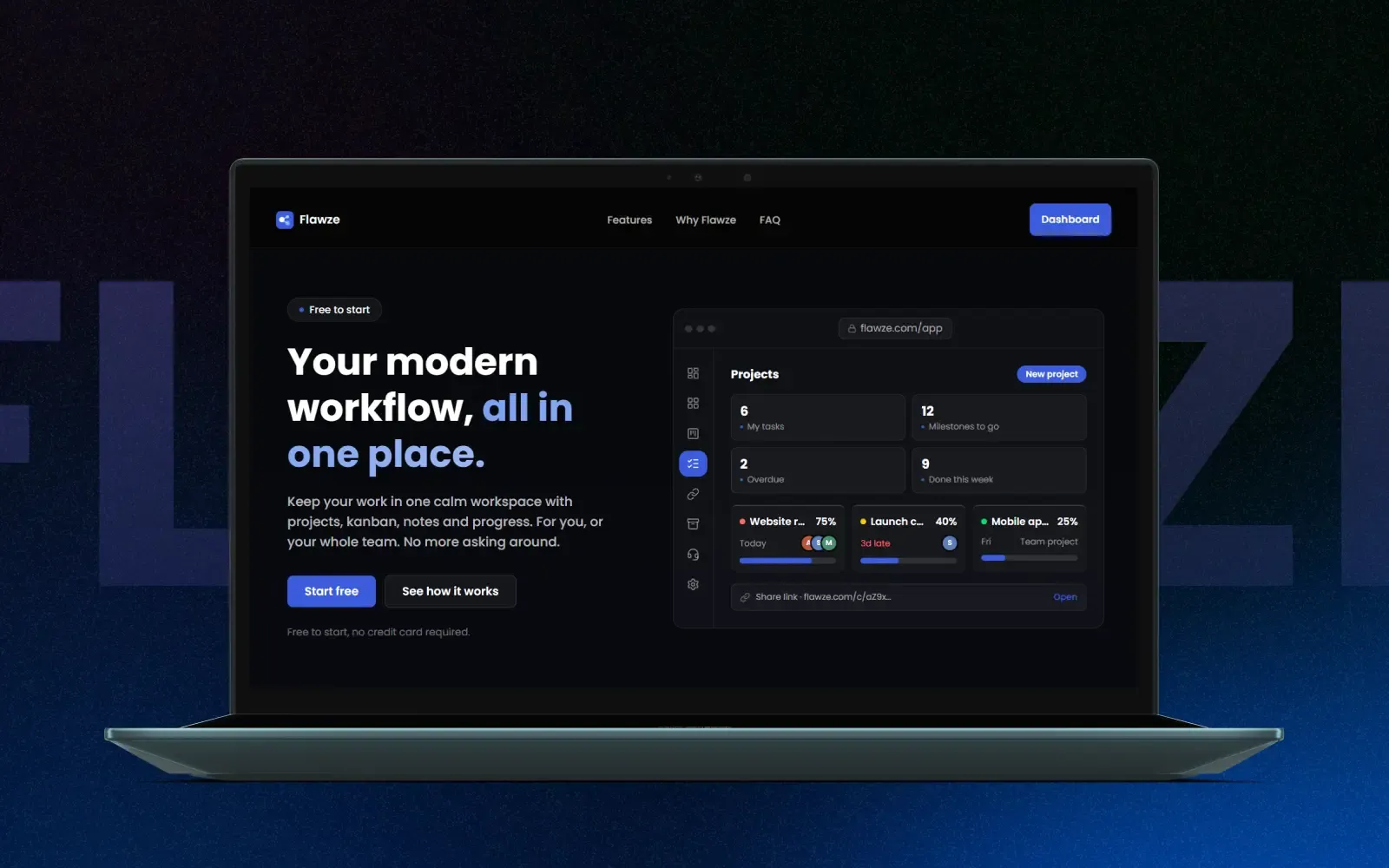
Flawze is a unified workspace designed to help individuals and teams manage projects, organize work, and track progress in one calm, connected environment. The project aims to bring personal productivity and team collaboration into a single system, eliminating the need for separate tools for different ways of working.
Problem
Managing personal projects and team collaboration often involves switching between different tools for tasks, notes, progress tracking, and communication. This can create fragmented workflows, make project progress harder to understand, and introduce unnecessary complexity.
Flawze addresses this challenge by bringing essential work surfaces into one workspace. The key challenge was to support both individual and collaborative work without creating two separate products or compromising the simplicity of either experience.
Another important challenge was defining clear boundaries between different types of work. Project management needed structured assignments, priorities, due dates, and milestones, while Kanban needed to remain flexible and Notes needed to provide a dedicated space for written knowledge.
What I did
I shaped Flawze around a unified workspace model with two space types: personal and team. Rather than building separate personal and team applications, I established a shared foundation that supports both experiences while allowing collaboration-specific features to appear only where they are relevant.
The product follows a core workflow: Space → Project → Assignment → Work → Activity → Progress. Projects serve as the primary unit of work, with assignments, priorities, and due dates managed at the project level. Milestones provide a checklist for tracking progress, which is calculated automatically from completed milestones rather than manually entered.
I also defined distinct roles for the workspace’s main features:
- Spaces, Personal spaces provide a private environment for individual work, while team spaces support shared work, member management, and collaboration.
- Projects, A structured way to organize work, assignments, priorities, due dates, and milestones.
- Kanban, A flexible board for free-form cards and custom columns, kept separate from project-specific assignments and progress tracking.
- Notes, A Markdown-based library organized into folders, with limited project linking to keep information connected to relevant work.
- Share progress links, Optional, read-only project links that can be password-protected or revoked. External viewers do not need an account and cannot modify project data.
- Team collaboration, Team spaces support joining through an eight-character code with owner approval, along with shared boards, assignments, and member management.
A key design decision was to keep the experience consistent across personal and team spaces while restricting team-specific features to team environments. This allows Flawze to maintain one coherent product model without introducing unnecessary complexity for individual users.
Outcome
The result is a clearly defined product direction for Flawze: one workspace model that accommodates both personal productivity and team collaboration. Its core features have distinct responsibilities, allowing projects to provide structure, Kanban to support flexible planning, and Notes to organize written knowledge.
Automatic progress calculation establishes a consistent way to understand project completion, while read-only sharing provides a controlled way to communicate progress outside the workspace. The distinction between personal and team spaces also creates a foundation for collaboration without requiring separate applications.
Together, these decisions establish Flawze as a unified workspace built around clarity, flexibility, and a consistent approach to managing work.